AI assistants such as Google Gemini or ChatGPT have become part of people’s daily lives, helping with tasks like generating recipes, offering fitness advice, or sifting through multiple sites to find the best answer to a question. What if that same type of assistance could be applied to physical spaces?
Airports have made meaningful progress with dynamic, digital mapping, but navigating busy terminals remains a persistent challenge, whether it’s locating gates under tight schedules, finding amenities, or moving through crowded baggage claim areas. As terminals grow more complex and passenger expectations continue to rise, there’s an opportunity to go beyond static interactions and introduce more natural, responsive ways for travelers to engage with maps and receive guidance that adapts to their context in real time.
Atrius Wayfinder already provides tailored, map-integrated guidance across the airport. Adding conversational AI can introduce an effortless passenger-first experience, allowing passengers to ask questions and see exactly what they need: routes, places, and services, highlighted in real time, without navigating menus or filters.
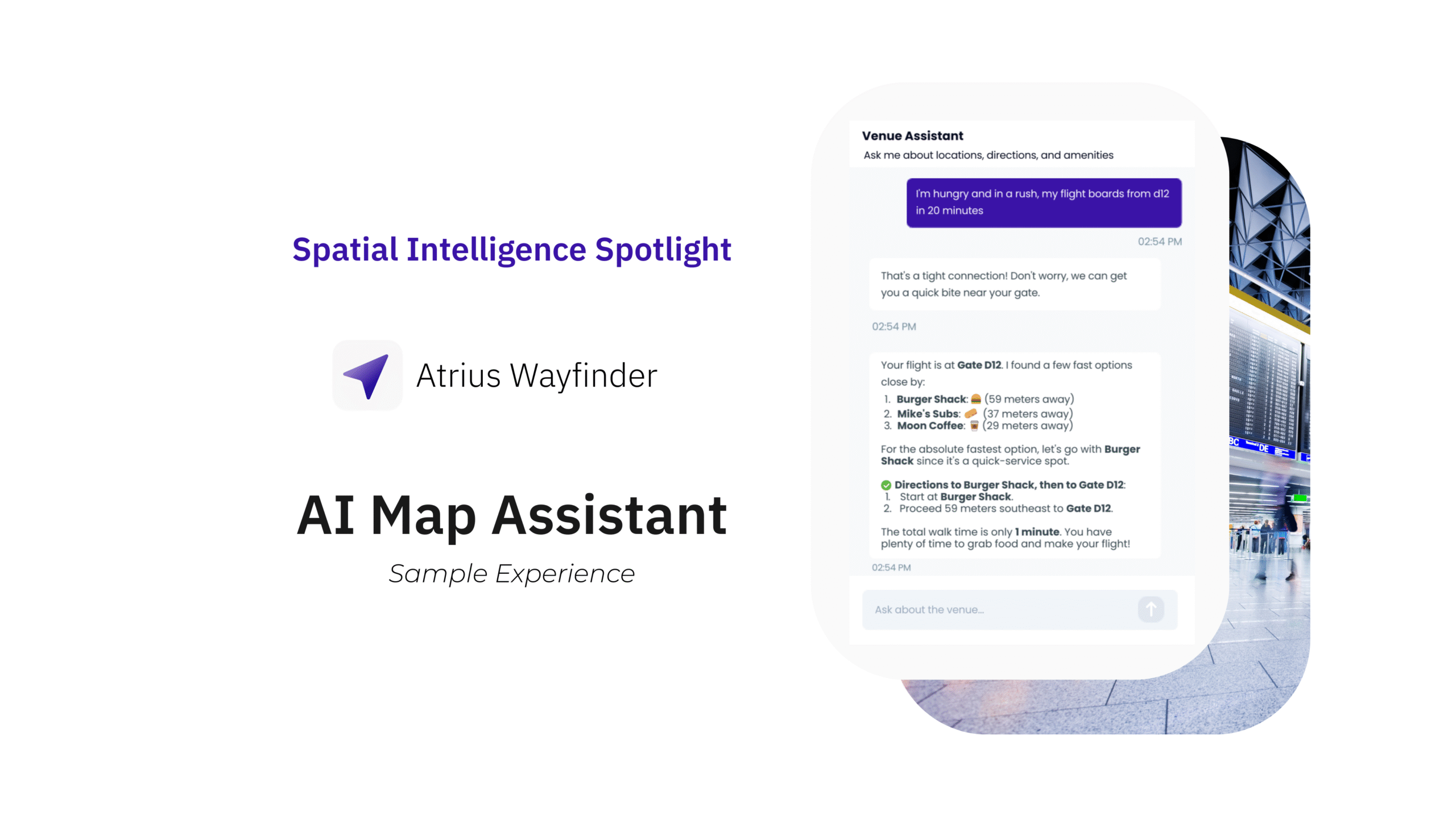
Passengers have questions. It’s time to let them ask! Experience the possibilities with Atrius Wayfinder’s experiential concept called AI Map Assistant, a demonstration we’ve built to help illustrate how AI-powered, conversational guidance could be implemented using map data.
Note: AI Map Assistant is a sample experience built by our development team to show how customers can build an AI solution using existing Atrius Wayfinder maps. Please reach out to us if you’d like to get hands-on access to this sample experience.
What is AI Map Assistant?
AI Map Assistant is an interactive demonstration that shows how Atrius Wayfinder map data can support conversational interactions across web, chat, or mobile environments. It is not a complete solution; rather, it serves as a starting point for airports and airlines exploring solutions to design and implement their own AI-powered guidance using their own map data, while leaving room for customers to integrate their own systems, partners, and workflows to create a complete, production-ready experience.
Powered by rich venue data, including layouts, points of interest (POIs), routing, navigation paths, services, and real-time updates, this experience showcases how a customer-built solution could enable passengers to interact naturally, chatting as if they were speaking with a helpful concierge to find their way through the airport and receive timely, in-the-moment, wherever a passenger is within the airport.
Passenger Search Examples
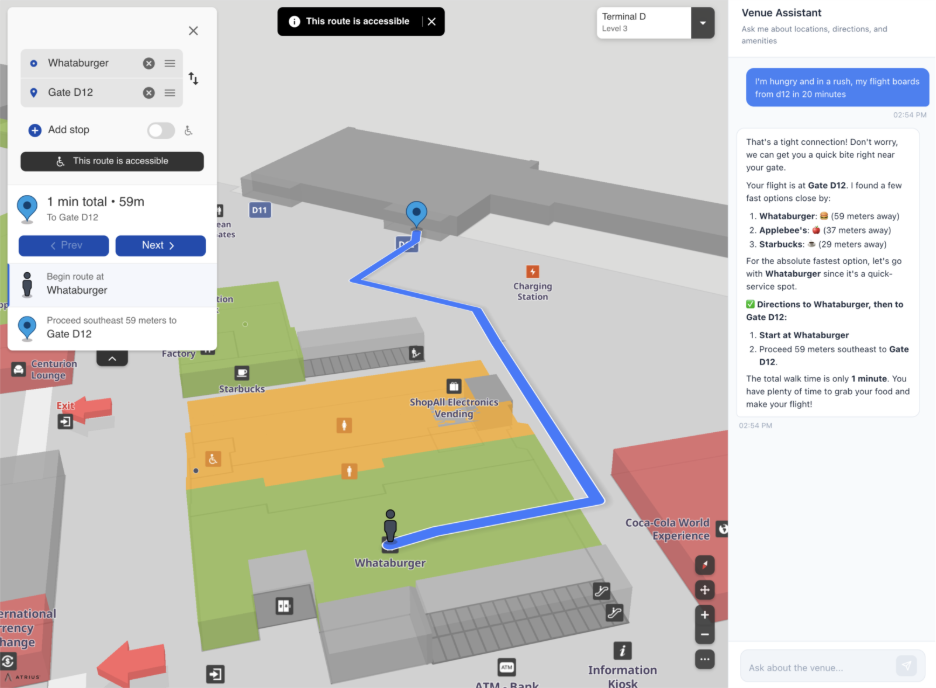
AI Map Assistant showcases the blend of conversational search with venue-specific data tailored for airports:
- Natural Language Queries: Instead of browsing category menus, visitors can ask questions as they would a friend or airport staff, such as “Where’s my gate?” or “Show me the nearest coffee shop”.
- Context-Aware Responses: AI Map Assistant considers the full picture, including time pressures or preferences. For example, if someone asks, “I’m hungry and in a rush”, it can suggest quick options; if they ask, “I want something more upscale than a grab-n-go meal,” it can point out alternative options.
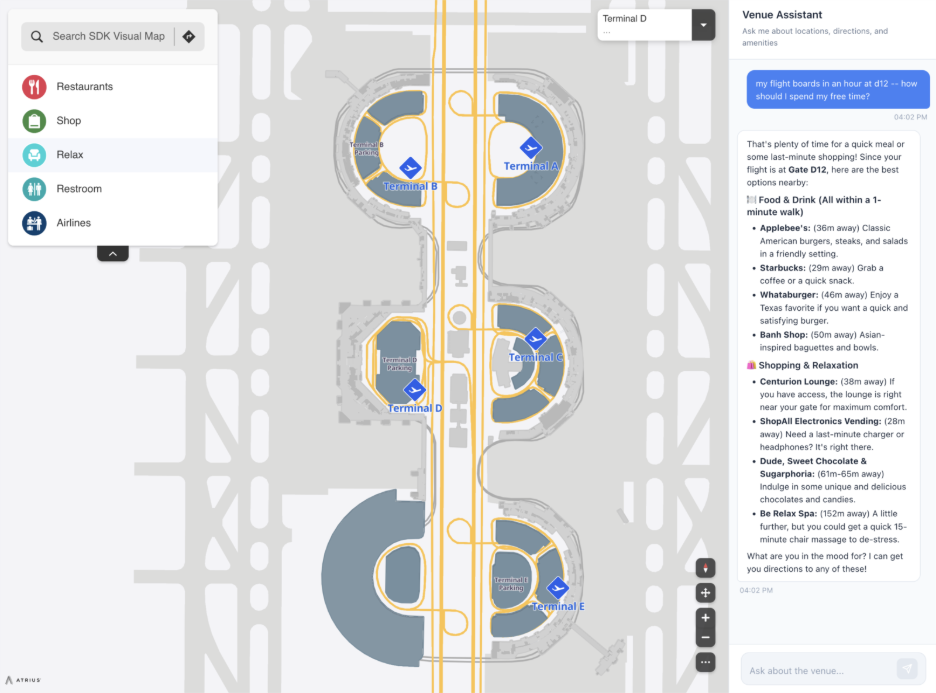
- Personalized Journey Planning: Factor in specifics like flight times or current location for spot-on recommendations. Take “My flight leaves at 2pm from Gate B12 – where can I grab a drink?” It might suggest a low-wait time concession on a passenger’s route.
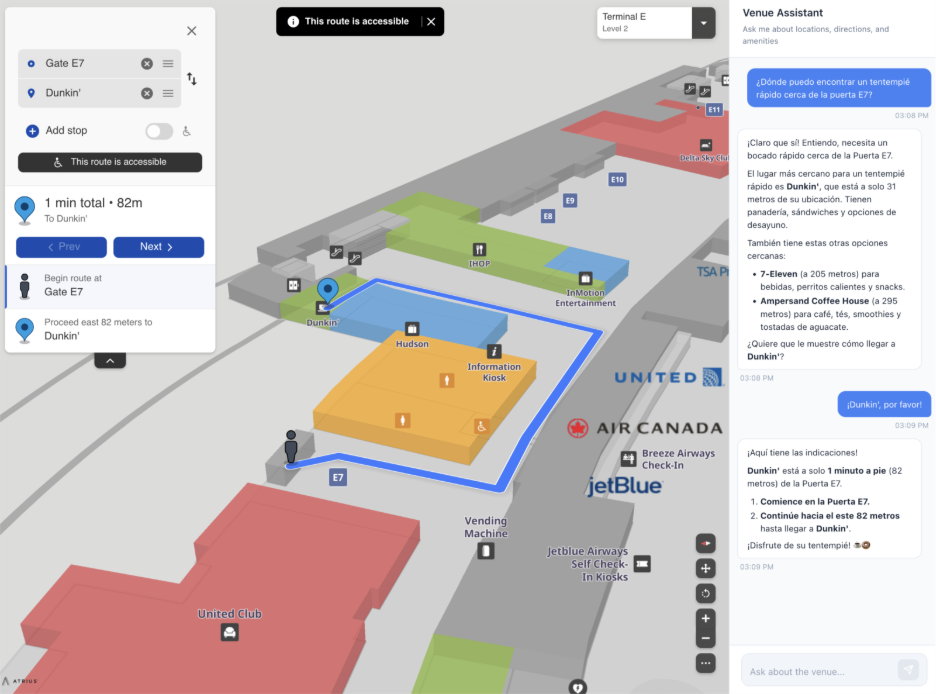
- Multilingual support: The experience can be built to enable multiple languages to support passengers from various countries around the world.
These elements can make your airport map a forward-thinking guide that minimizes passenger stress, increases personalized experiences, and maximizes airport efficiency. It can be implemented across digital touchpoints, including kiosks, mobile apps, and website experiences.
Ready to Get Started? Don’t Start from Scratch: Try it Yourself
Not sure where to start? Want to explore partnership opportunities? We’ve already done the heavy lifting to help you explore the best path forward.
AI Map Assistant is a fully functional sample experience that bridges the gap between your Atrius Wayfinder maps and conversational interfaces. It runs locally, works with your data, and demonstrates exact patterns you need to get started immediately. Schedule a demo and get access to the AI Map Assistant sample experience to see what’s possible for your specific venue type and use case. Get in touch for a live demo and access →
Real-World Examples in Action
AI Map Assistant can help you explore examples and innovative ways to interact with key passenger touchpoints across multiple digital channels, including website chatbots, terminal kiosks, and mobile apps.
To illustrate how customers might leverage conversational search, consider these passenger interactions:
- Pre-Arrival Planning (Website Chatbot)
Provide clear directions and visual routing, helping passengers orient themselves before or upon arrival and reducing post-arrival congestion.
Airport value: Reduce call center demand and empower passengers before they arrive. - On-the-Go Assistance (In-Terminal Kiosk)
Recommend efficient, en-route options such as nearby kiosks or grab-and-go locations to minimize dwell time and prevent delays.
Airport value: Improve passenger flow, reduce congestion in high-traffic areas, reduce missed connections, and increase ancillary revenue. - Personalized, In-Moment Support (Mobile App)
Prioritize the most accessible and optimal dining options along a passenger’s route, tailored to their location and time constraints.
Airport value: Provide personalized assistance at scale, increasing passenger confidence without adding operational overhead.
By adapting to context, location, and intent across channels, there are more ways to deliver responsive guidance, improving passenger satisfaction while supporting smoother operational flow.
Unlocking Smarter Airport Experiences with Conversational AI
Implementing conversational AI isn’t just about updating new technologies. It’s about the real impact to help save time, streamline operations, and increase passenger satisfaction:
- Enhanced Passenger Satisfaction: Make the journey from curb to gate smoother and more enjoyable, resulting in higher customer satisfaction and opportunities to increase ancillary revenue.
- Operational Efficiency: Reduce congestion at information desks and concierge queues by enabling passengers to self-serve answers to repeatedly asked questions. This eases pressure on airport staff and allows teams to focus on higher-value, in-person support where it’s needed most.
- Commercial Performance & Retail Optimization: Empower passengers to explore more, boosting time spent in shops and restaurants, which can translate to ancillary revenue growth and optimized retail partnerships.
- Accessibility and Inclusivity: Implement natural language support to diverse audiences, including those with disabilities, language barriers, or mobility needs, ensuring as many passengers as possible experience your airport.
- Scalability: Easily integrate across multiple devices, from apps to kiosks and websites, for consistent experiences throughout the terminal, gates, and concourses.
A Leap Forward in Airport Navigation
Our Atrius AI Map Assistant sample experience represents an innovative leap forward in airport navigation, blending AI and comprehensive map data to deliver intuitive and personalized guidance. For our customers ready to modernize their maps, learn more on our documentation page or contact us to schedule a demo and get access.
Want to learn more about Atrius Wayfinder? Let’s chat.